About Joe

I'm the idiot who made this blog, because I apparently don't have enough blogs or free time.

Retro vs Modern Games — Hand-holding

The almighty algorithm led me to watch a video by a younger adult gamer comparing and contrasting modern with retro games in terms of what might be called “hand-holding”. It’s a great video from a very different perspective than my own. For example, I thought the brief discussion of NPCs was interesting — using “NPC” as an epithet is a relatively recent development as far as I’m aware. Viewing NPCs as a contrast to the player’s perceived agency and autonomy is an interesting framing — I’ll just say I don’t know that those who really embrace that perspective have really thought this all the way through or that they’ve carefully questioned what such a framing says about those who embrace it.

However the main thrust of the video concerns a pretty reasonable (and not uncommon) sense that retro games don’t hold your hand nearly as much as modern ones, and that in some ways this move to more hand-holding is not an entirely positive development. I certainly agree with the empirical observations — modern games absolutely take more care (in-game) to guide the player through the learning stages of their various systems.

What I love about hearing other folk’s perspectives is trying to understand their context. The creator of the video in question primarily contrasts modern games with a certain era of games — the mid- to late-90s. Final Fantasy VIII and Ocarina of Time are used as primary examples.

Of course from my perspective (my earliest gaming memories date from the 80s), these two games were themselves part of a larger break from previous eras of gaming. Ocarina held the player’s hand a bit more, as I recall, than A Link to the Past, which in turn was a huge improvement in those terms over the first two TV console Zelda games. To be fair, Navi (Link’s attention-demanding fairy companion) was often more annoying than helpful, but overall the trend was not unintended nor unnoticed.

I should also mention that part of the reason that particular era’s retro games feel more hands-off in terms of player guidance than modern games is that these were definitely part of the first big generation of 3d console games. A lot of ideas were being tried and a lot of problems had to be grappled with. So some of the perception that the games were more respectful of the player’s intelligence, agency, what-have-you is really more a consequence of some problems being addressed and others being viewed as less of an issue. How to use cameras in 3d games was a tremendous challenge, I think, which is why so many of the games from this era are so awkward to play now.

So from a younger player’s perspective, games from that era of first-get 3d consoles represent something different than they do to a middle-aged gamer like myself. And that’s pretty reasonable — games have evolved pretty dramatically in some ways, I think, so the contrast between modern games and the most recent games that can are considered retro is pretty significant.

In the modern era we have settled on some elements of game and/or control design that dominate new games. This is not some unique development. This is kind of always happening, as well it should. One of the challenges that games face is acquainting the player with the game’s various systems. These systems can be innovative, but the developers have to strike a balance between novelty and modern conventions so as not to lose too many players to frustration. Retro games with high barriers to entry had high barriers back then as well — not everyone thought drawing maps on graph paper in order to slowly & painfully progress in The Bard’s Tale was a fun time. It certainly kept a lot of folks at a distance. I’ve been playing a little Phantasy Star lately thanks to the Switch “Sega Ages” version, which provides simple but welcome amenities like auto-mapping and fast-forward. I had no patience for it before, and I have better ways to use my brain than berate myself for not doing tedious grunt-work for an RPG, or to feel that I’m somehow cheating myself of the “true” experience. These games had very limited audiences and a huge part of that was all that friction. And I’m talking about games that I consider to be groundbreaking, fantastic games. But the games were designed in a different context with different challenges and incentives. That’s just how this stuff goes.

If I have any criticism of the video at all it’s that the video’s creator engages in a short bit of entirely unnecessary and inaccurate self-deprecation where she refers to herself as a “dumb girl” or something. Her thoughts were interesting and astute, and certainly provoked a lot of reflection and thought on my part. And that’s not even really a criticism of her, as much as it is that such social lubrication is required at all. But that’s still the world we’re in at the moment, sadly.

Clair Obscur: Expedition 33

I started playing Clair Obscur after hearing some praise for it from a gaming podcast I listen to. It was (and still is) on Xbox Game Pass and that’s how I played it, though I’ve since canceled my Game Pass Ultimate subscription after the 50% price jump. I then picked up a physical copy so I can revisit it and perhaps play through a New Game+ at some point. I think it will be a while until I do come back to it.

I say that because I played this game while going through a very difficult time this summer. My mother was diagnosed with stage 4 breast cancer and things happened very quickly. We lost her in early July. I started playing the game a little after she was diagnosed, but don’t hold me to any details. After she passed I didn’t play it again until a few weeks ago, at which time I went ahead and completed the game’s story.

It was an interesting game to play when I did, and I’m glad for that. I’m not going to say that it made things easier or even provided significantly more comfort than the normal ways that immersing yourself in something can help you get through some things, but I do think it played a positive role in how I endured (and continue to endure) a terrible experience.

I say all that to provide context for my high opinion of the game. I absolutely adored it. Things I thought I’d dislike (dodging & parrying in particular) became some of my favorite parts of the game. The turn-based combat (and really the game in general) felt like a love letter to Final Fantasy without coming across as some pale imitation. The fights were often challenging but doable, and if they felt unwinnable, I could go explore other things for a little bit and come back with enough improvement to win. I don’t think I ever really did any grinding (not that I mind doing so).

I loved the characters, who all felt like real people trying to make the best of a remarkably bleak life and future.

I haven’t done enough writing in recent years and I feel out of practice and unable to express myself as clearly as I’d like, so I’ll not say much more for now. But I’ll conclude by saying that Clair Obscur was, for me, more than the sum of its parts. It does many, many things very well and has few shortcomings as I see it. But in a time that has been particularly difficult for reasons explained above and (frankly) the upsetting and scary state of things in the USA right now, it rose above “great game” status to truly weave itself into my life, and it was a wonderful way to both help distract me when I needed it and help me process things when I needed that. The folks responsible for this game accomplished something pretty special, I think, and they should be proud of their work.

It’s 2025!

It’s been the better part of a decade since my last post, which itself was a long time coming. Thought I’d drop in some updates. And who knows? Maybe I’ll start updating here more frequently. I wouldn’t mind putting my thoughts and experiences with games and gaming down, if only because organizing my thoughts appeals to me.

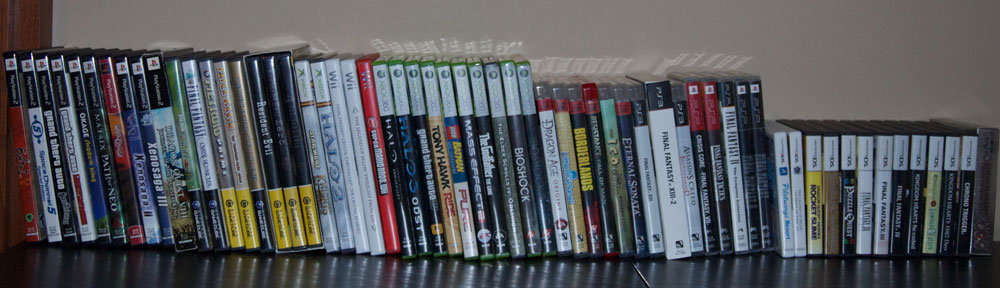
Near the start of the pandemic we finished our basement and I (finally!) got my game room. Or, actually, a game room / office. I work from home now and I work from the game room. Anyway, I now have a home for my voluminous collection of games going back to the Atari 2600. And the amiibos. So, so many amiibos.

Rocket League®

I play a lot of Rocket League these days. It’s a fun, challenging game. The general attitude of your typical random player leaves a lot to be desired, but it’s a testament to the game that it’s still worth playing despite such nonsense. I’m not highly-ranked at all, but I’ve improved over the years and will likely play it for years to come, assuming it doesn’t collapse or something. Which, I mean, it could. I’ve got a small collection of pretty silly Rocket League videos over on TikTok.

I’m still collecting consoles, but I definitely use Analogue consoles for normal gaming. When possible, I have consoles running to both an LED and a CRT. I’ve got several consoles with ODEs (PS1, Saturn, Dreamcast, GameCube). And of course I have an Analogue Pocket, which is a solid product.

My son (13) enjoys old games and has a taste for analog tech, so he’s got my SNES hooked up to a small CRT in his room. He also recently got a record player and he loves vinyl records, which is interesting. Still, he is a teenager and definitely plays a lot of modern games, especially with friends. Which is great.

My daughter (9) plays console games a little less, but she loves Mario Kart 8. Minecraft as well. They both play that, actually, along with Roblox.

I’m not entirely comfortable with Roblox. I can ramble about that another time, maybe.

I play a weekly game with some friends that, at the moment, rotates between Borderlands games (currently Tiny Tina), Helldivers 2 and Rocket League.

In the tradition of Stack of Shame, I’m currently trying to “finish” God of War: Ragnarok and Balatro. Balatro has come to the fore for me lately, but I’ll get back to GoW soon.

Anyway, I’m going to try to regularly write here. I likely won’t adhere fanatically to the premise of the blog (finishing my backlog) in favor of just writing whatever I want to about video games and gaming culture. We’ll see!

The Last Three Years

So it’s been about … three years since my last update. I didn’t have a daughter then. She’s three now. So I guess I’ve been a bit negligent here.

A random list of video game related stuff I’ve done in the last few years:

  • Got a PS VR. I don’t play it a lot, but it is fun, especially when family visits.
  • Got a Nintendo Switch. I love this thing.
  • Got a SNES Classic and played through Super Mario World. I used save states and cheated my way through it. Totally enjoyed it.
  • Played and beat Bravely Default. Bought Bravely Second; may start it soon.
  • Played some Final Fantasy XV. Didn’t get hooked. Sad that I didn’t. May try again.
  • Played some Zelda: Breath of the Wild. Also didn’t get hooked. May try again.
  • Beat Super Mario Odyssey. Fantastic game. My son got obsessed and got farther than I did.
  • Bought Skyrim for the Switch and did a complete play through except for Dawnguard, which I’ve strangely not played on any platform. No idea why.
  • Beat West of Loathing. Fantastic, ridiculous game.
  • Her Story. Great game. The less I say, the better.
  • Really, really tried to play Fallout 4. I sucked at it bad. Embarrassingly so.
  • Played about 5 hours of Baldur’s Gate. It was sorta fun; not for me.
  • Got a Nintendo Everdrive, a GBA Everdrive and an SNES2SD. They’re fantastic.
  • Backed the Bard’s Tale IV kickstarter. Waiting on the Mac version.
  • Backed the Shenmue 3 kickstarter.
  • Backed the Flip Grip kickstarter.
  • Backed the Micro Mages kickstarter for just the ROM, because I have a Nintendo Everdrive now.
  • Played The Beginner’s Guide. Loved it.
  • Became briefly, intensely obsessed with Minecraft, then lost all interest (for now?).
  • Got an Analog Super NT. I love it.
  • Got a small PVM for analog consoles.
  • Bought about 30 Amiibo. Shut your mouth.
  • Made zero progress on my game room.

Skyrim

I probably don’t have a lot to say about Skyrim that others haven’t said. I will say this — it’s a testament to how good of a game it is that I put around 500 hours into it despite it being shockingly buggy. And seriously, it is a very buggy game. It is easy to do normal things that result in the game crashing (which isn’t so bad) or losing items (very bad).

Still, it is a great, great game. It’s not for everyone, of course, but it taps right into a super-addictive part of my brain that could probably be exploited by heroin or pogs or something. I took my PS3 with me on vacation to the in-laws so I could play it. When we arrived and I realized that I had forgot to actually bring Skyrim, I went out and bought a used copy (from Trade-N-Games) so I could continue playing it.

So maybe I have a problem.

As I mentioned in my previous post, I finally got around to completing the main quest a few weeks ago. The main quest was great and could probably stand alone as a game itself, but of course it’s everything else in the game world that makes the game so good. I’m not really sure that I’m done with it, even though I’ve started playing Crisis Core: Final Fantasy VII and Super Mario Galaxy 2.

Updates

Yikes! I haven’t updated in a while.

I have been busy though. I put a lot of time into Skyrim. I’ll probably write something about it.

Photo of Nintendo controller with LED modification

I’ve spent some time working on some hardware stuff, including this fun NES controller modification.

I’m also ramping up to selling some modded original Xboxes.

As for games, I’m considering a few to play next. Maybe a JRPG.

Game Boy Repair

A few months ago I stumbled across a red Play It Loud Game Boy in a Goodwill. It was in very good condition. Unfortunately, it wouldn’t run off batteries.

I was able to fix it. I recorded a video of the process.

I suspected that the problem had to do with the battery contacts. It appeared that some batteries had leaked on them at some point. It turned out that was the problem, and now it works great!

Gamergate

Anyone who has been paying attention to the gaming world has heard of #gamergate at this point. I’ve been a mostly silent observer until fairly recently. I did a lot of retweeting, but otherwise didn’t participate.

I made a single tweet in the gamergate hashtag last night expressing my anger with the reactions from #gamergate folks to the sociopathic harassment of a female game developer.

I was almost immediately responded to by #gamergate folks trying to brush the event aside:

https://twitter.com/NeonCinder/status/520787995210035201

I’m not going to go into all the substance of the conversations here. I’ve linked to the chain of tweets if anyone wants to read them themselves.

The rapidity with which several people jumped in demanding evidence or downplaying it was concerning. I have not been particularly vocal on this issue up to this point, despite following it closely. I am not in any way a prominent or controversial figure in the debate. So I can only imagine how maddening it is for people (predominately women) targeted by #gamergate.1

What I find most frustrating is the stubborn refusal to acknowledge #gamergate’s harassment problem. There are people in #gamergate on one hand talking about how they’re a grassroots movement2 that has concerns with X, Y and Z. But when people associated with them act poorly, they fall back on claims that no one person speaks for them and that there are jerks in every contingent. The problem here, which you see in regular politics as well, is their priorities. When a game dev, critic or journalist receives death threats and/or doxxing, their first response is to defend their movement or to claim that people on their “side” are being harassed. That does not do much to help the “other side”3 view them as people acting in good faith.

Here are my main gripes with #gamergate, in no particular order:

  • It was kicked off by attempts to shame a female indie dev for her sex life.
  • It concerned itself early on with attacks on Anita Sarkeesian4.
  • Women (particularly outspoken women) are disproportionally targeted.
  • People (especially those prominent in the industry) who voice support for targeted women are themselves targeted.

By targeted, I mean harassed, abused and doxxed.

The responses I’ve heard from folks are disappointing. It’s a common political tactic to try to brush aside history (recent or otherwise) and pretend that a movement, as it currently exists,5 is all that matters.

But history does matter. This movement was kicked off with misogynist attacks. It has its origins in slut-shaming. It only pivoted when prominent gaming websites broadly condemned the slut-shaming of Zoe Quinn and the attacks on Sarkeesian. Under fire from game journalism outlets, they changed their message from misogyny to “ethics in gaming journalism”.

This is when a broader audience joined #gamergate. The rash of “Gamers are Dead” articles rubbed a lot of folks the wrong way.

The problem is, history matters. Out of context, the “Gamers are Dead” articles might look mean-spirited and nasty. But these are articles written by gamers. They are writing about what they see as a watershed moment, where they acknowledge the widespread appeal of games and sever relations with a particularly childish, abusive contingent of gamers. They are talking about the death of non-inclusive, misogynist gamers who want ultimate authority on what is a game and who is or isn’t a “gamer”. They are talking about people who accuse people of being “Fake Gamer Girls”; people who want and enjoy an abusive, confrontational environment.

They were saying, “this is not just for you anymore”. And it’s not. Gaming has long sought legitimacy as an art form. Criticism of it from the likes of Sarkeesian is a sign that it is being taken seriously. Games are unquestionably art and are unquestionably political. That is a good thing.

I am open to discussion with #gamergate folks who argue in good faith. I’m also under no illusion that I will convince them that they’re in the wrong. But my patience runs thin for those who want to brush aside the origins of their movement and the very damaging, abusive people in their midst. It runs thin for those who respond to the abuse of others by downplaying it, moving goalposts or simply changing the subject.


  1. And to be perfectly clear here — I am not whining. I wasn’t overwhelmed with responses and I am not in any way characterizing this as harassment. I am merely commenting on the immediacy of the replies. The volume of responses balloons for people more involved. 
  2. The claim that #gamergate is a spontaneous, grassroots movement is demonstrably false. 
  3. I profoundly hate language like, “other side”, “two sides”, etc. and I’m using it somewhat ironically here. This sort of language is by definition polarizing and obscures real issues. It’s bullshit like this that encourages people to downplay the bad behavior of others associated with them. I realize that people on both, ahem, “sides” might disagree with me on this. 
  4. I say early on, because #gamergate has tried to distance itself officially from the harassment of Sarkeesian. The harassment and abuse continues unabated, though. 
  5. That’s being generous. #gamergate is still associated with abuse and doxxing, whether supporters like it or not. 

Misc Updates

So here’s a rambling summary of the last couple of months.

The last two months have been bonkers. At my job there’s a huge push to get large projects out the door around this time of year.

So my game-playing has been sporadic. I’ve fallen back on some quick-fix games. Specifically, Mario Kart 8 and Sonic & All-Stars Racing Transformed. It doesn’t hurt that my kid loves watching me play them.

I don’t have much to say about Mario Kart 8 — it’s awesome and everyone knows that. I haven’t played any online matches yet, unfortunately.

Sonic Racing (on the Wii U) is actually a pretty great game. I played it a little bit on the Vita a while back, but it’s better on a large TV. It’s also a nice contrast with Mario Kart — they’re superficially similar, but they’re actually very different games. You accrue XP in this game and progress through branching paths to different races and challenges.

I’ve also dabbled with a few RPGs. I’ve played a few hours of Earthbound. So far I really like it, and it’s possible I’ll play through the game. I’ve also played a little bit of Planescape: Torment, a game I’ve heard a lot of good things about. So far I like it, but I’m not used to that style of RPG, and it’s taking a little getting used to.

I played some Lunar: Silver Star on PSP a month or so back, but unfortunately I got distracted. I’ll have to pick it back up.

So I’m doing my usual waffling around between games, but I don’t feel so bad about it right now.

I’ve been thinking about doing some repair videos, specifically for an Xbox 360 and an original Game Boy.

Heavy Rain

I finished Heavy Rain last week (I had started it a few months ago, but wasn’t able to come back to it until a couple of weeks ago). Overall, I really liked it. What follows is fairly spoiler-free.

I only had a few complaints. First, I got the Really Happy Ending for Ethan, Madison and Shaun. That was fine, but Madison’s dialogue felt very contrived and unnatural. It almost ruined an otherwise great voice experience throughout the game.

Second, the quicktime events weren’t actually so bad, but a couple of times I meant to do one thing, and it turned out that I did another. For example, I intended to help untie another character, but the action I chose was to deliberately not help her. I reloaded the game because that didn’t feel right. It’s one thing to try to do something and fail, but it’s something else to accidentally do the entirely opposite thing that you intend. None of this is that big of a deal, but it does really pull you out of the story.

I enjoyed it overall. The main plot is very disturbing, which isn’t necessarily a bad thing. It’s disturbing in kind of the way that Seven, for example, is. Anyone would find it troubling, but being a dad really did make it tough to stomach at times. Apparently the goal of the developers was to evoke emotional reactions. They succeeded, though I’d stipulate that showing children in mortal danger is kind of an easy (perhaps even cheap) way to do it.

The reveal of the killer’s identity took me completely by surprise—they did an excellent job of misdirecting the player (or me, at least) while still putting significant clues directly in front of them.